Modesto Is Growing. Most Local Business Websites Aren't.
Something is shifting in the Central Valley. Modesto, Tracy, Manteca — these cities are growing fast, fueled by people moving inland from the Bay Area and East Bay looking for space and lower cost of living.
They're bringing Silicon Valley expectations with them.
These are people who order groceries through an app, book doctors without picking up the phone, and form opinions about a business before they've spoken to anyone there. When they land on a local website that looks like it was built in 2016 and hasn't been touched since, they don't think "this site needs an update." They think "this business is behind."
That gap between what new Central Valley residents expect and what most local businesses are offering online is widening. And you can measure it.
Three seconds. That's the whole audition.
53% of mobile users abandon a site that takes longer than three seconds to load. Not thirty seconds. Three seconds. And nearly half of people now expect pages to load in two seconds or less.
For every one-second delay in load time, conversion rates drop measurably. Google's own research found that as page load time goes from 1 second to 3, the probability of someone bouncing increases by 32%. That's not a design preference. That's revenue walking out the door.
Most business owners I talk to assume their site loads fine. Almost none of them have actually tested it on a phone over a normal cell connection. Try it sometime. The results are usually humbling.
Nobody's calling anymore
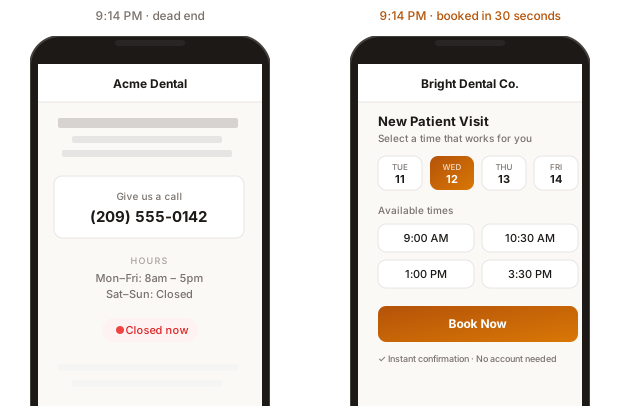
Over 70% of Gen Z and Millennial consumers prefer booking online over making a phone call. That number keeps climbing. The majority of younger consumers specifically want the ability to compare options and book instantly, without waiting on hold or leaving a voicemail.
If someone in Modesto is looking for a service at 9 PM on a Tuesday, and your site's only call to action is a phone number, you've already lost that lead to whoever has a booking button.
89% of consumers say they'll go to a competitor after a bad experience on your site. Not "might consider it." Will.
This isn't a generational quirk. It's how people interact with businesses now. The phone call isn't dead, but it's no longer the front door.
Fifty milliseconds
That's how long it takes someone to form an opinion about your website. A twentieth of a second. Before they've read a word, they've already decided whether your business feels credible.
75% of consumers judge a company's credibility based on website design alone. Nearly half say design is the single biggest factor in whether they trust a business.
You can have the best service in Modesto. If your site looks like a template from 2018, people decide you're not serious before they find out.
What this means locally
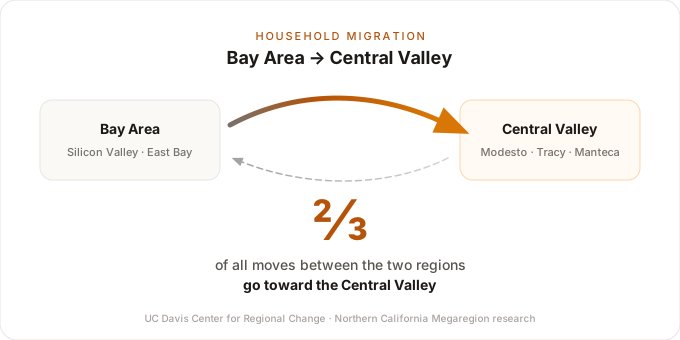
The Central Valley isn't an isolated market anymore. UC Davis research on the Northern California Megaregion found that household movement from the Bay Area to the Central Valley is two-thirds larger than the reverse. Smaller cities like Patterson have seen 10%+ population growth in just a few years. Modesto is absorbing the same wave at a larger scale. That flow isn't slowing down.
Every one of those new residents is a potential customer who's been trained by Stripe, Amazon, and Apple to expect a certain baseline from any business they interact with online. When they land on a local site that doesn't meet it, they don't lower their standards. They find someone else.
The uncomfortable truth: most Central Valley businesses haven't caught up yet. Which means the ones that do have a real advantage.
The short version
| What the research says | The number |
|---|---|
| Mobile users who leave after 3 seconds of loading | 53% |
| Consumers who judge credibility by design alone | 75% |
| Young adults who prefer online booking over calling | 70%+ |
| Users who won't come back after a bad experience | 88% |
If your site is the same one you launched a few years ago and haven't touched since, it's not just sitting there being neutral. It's actively filtering out the customers who've moved to the area most recently — and who probably have the most disposable income.
That's the experience gap. And in a market that's changing this fast, it's worth closing.

Written by Austin Osorio
Founder & Lead Engineer at loudbark.dev
Austin is a software engineer and the founder of loudbark.dev. A lifelong resident of the Central Valley, he has over six years of experience building high-performance systems. He started loudbark.dev to close the gap between what enterprise companies build and what local businesses can afford.
I use AI as a drafting and editing tool. The direction, advice, and technical detail come from me — I outline the topics, vet the facts, and edit everything before it goes up.
Related
I Audited 124 Modesto Contractor Businesses. Most Sites Can't Take a Lead.
The largest contractor market I've scanned. 124 businesses, 87 websites, and 53% with no contact form.
Modesto Law Firms Have 84 Average Reviews. Their Websites Have 5 Pages.
Strong reputations, weak web presence. 36 Modesto law firms scanned — the reviews are great but the sites aren't showing it.
Want to talk about how this applies to your business?
Let's Talk